45 books. That's how many I've read and listened to since the last book review I posted. Whoops. Maybe I'll make time to post a few highlights.
Maybe.
Wednesday, December 18, 2019

Monday, January 28, 2019
Book Review - Ninefox Gambit

SciFi books often take on the difficult task of inventing much of the world they inhabit. From the places and people to the technology and rules of society in the story. Maintaining a balance of explaining enough to make the world believable (or at least, plausible enough for the reader to suspend disbelief) while not over burdening the story with so much detail the story bogs down is a complex challenge.
Ninefox Gambit comes off as a book that received award nominations not for it's achievement of the challenge but rather for it's ambition. An ambition that is not fully attained. Much is invented, but fractional explanations are multiplied and (not a spoiler, but in the theme of the book) multipling fractions doesn't not yield whole numbers or, in the case of this book, complete results.
The result is a story that can feel long and disjointed. While gaps in explanation can sometimes be said to be left to the readers imagination, in Ninefox Gambit they are sometimes so large as to pull the reader out of the story entirely and left wondering what is going on.
More damaging to the reader experience is the question of why the story exists repeatedly going unanswered. Gaps can be overlooked if there's a bigger (and understood) plot still present and actively pulling the reader back into the book. At several points in Ninefox Gambit it appears the purpose and plot are clear only to have the text reveal there is something different afoot and the reader is left with the choice of abandoning the book or continuing a series of unexplained new inventions and abstractions riddled with jarring timeline jumps and blended characters so ambiguously defined as to leave the reader wondering not only what is going on, but also by whom it is being done.
My guess is the book, marketed as the first in a trilogy, actually serves as long prequel to a more defined story that may exist later in the series. I applaud the authors inventions as far as they've made it, but they needed to be taken further or presented in a more organized fashion to result in an enjoyable read.
Favorite Quotes (in no particular order, and not disclosing enough info to be spoilers):
Cheris had Dineng send for another Sparrow to verify that the light was fatal. The Sparrow dodged a ribbon of light too late and was transformed into a mass of parallel slices and metal shrieks.
He was as susceptible as the next Shuos to thinking up ways to assassinate people with unlikely objects.
Immortality was like sex: it made idiots of otherwise rational people.
The two ways to win at gambling were to read the situation and know the odds.
Water the color of sleep, or sleep the color of water.
I shouldn’t have shouted at you. That was the point at which the meeting degenerated past all hope of usefulness. One of my instructors used to say to me that if I was ever about to lose my temper, do something productive instead, like draw hanged stick figures on my tablet where no one can see them, or think up death-traps using office chairs and nail clippers.
Saturday, January 12, 2019
Book Review - The RedBreast by Joe Nesbo
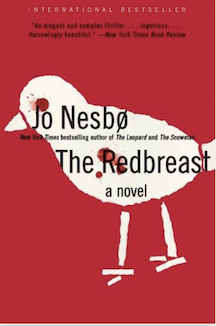
A well paced story with good depth.
A deeper story than the description portrays. Well developed characters and of the style that includes all the information you need to solve the mysteriey but embedded deep enough you won't feel bad for not catching on earlier (if at all). A good pace that both gives good background on the people, places, and events while keeping the story moving forward.
Favorite quotes from the book:
Unreliable paper boy. Inflicting serious gaps in my general knowledge.
it only rained twice every autumn in Bergen: from September to November, and from November to New Year.
Ellen Gjelten lived on the second floor of a recently renovated block of flats together with a tame great tit called Helge.(A favorite quote because at the time I thought (hoped?) 'tame great tit' might be a Norwegian term that didn't translate, it isn't but should be)
Helge didn’t answer. The one-winged bird blinked twice and scratched its stomach with a foot.(A favorite quote because it clears up the above and the detail and so few words gave me pause and made me smile)
Friday, June 15, 2018
Pseudo Book Review - Noir: A Novel
In lieu of a book review, I present you with my 13 favorite quotes from the book.

Noir: A Novel
by Christopher Moore
They can be a very large source of filthy lucre.
Sammy's got all the perspective of a bucketful of dark.
A lowbrow mug who wouldn't know how to treat a member of the gentler sex if she smacked him upside the head with a sack full of vaginas.
As serious as Saint Joan lightin' a cigar.
That mug couldn't catch a cough in a tire fire.
She took a pull on her drink until it made a delicate slurping noise — the straw at the bottom of the glass like a tiny parched elephant.
The night at work moved like honey poured over an iceberg.
I tried to pick Pookie up by the collar, but I couldn't get a good grip and he was a giant sack of staying put.
"Bow - wows and whistle berries!" Myrtle called into the window. "Two fat dagos in the straw! Bun pup, take a shit on it and make it cry!"
Sammy raised a questioning eyebrow to the Cheese.
"Franks and beans, two spaghetti and meatballs, and a chili dog with onions," Stilton translated. "I think she just made that last one up to show off for you."
"Considering what you been through, you're as sober as a church mouse."
"Isn't that ‘quiet as a church mouse'?"
"You'd think, but once you get a few drinks in those little guys, you can't stop them singing."
The sax man stopped playing, adjusted his reed, smiled out of the corner of his eye.
"The drama, doll. Don't add the drama."
"It's how I tell a story."
"But Sammy here does not need the extra drama. Look at the poor guy, he's dramatized already."
The stink would knock a buzzard off a shit wagon.

Noir: A Novel
by Christopher Moore
Sammy's got all the perspective of a bucketful of dark.
A lowbrow mug who wouldn't know how to treat a member of the gentler sex if she smacked him upside the head with a sack full of vaginas.
As serious as Saint Joan lightin' a cigar.
That mug couldn't catch a cough in a tire fire.
She took a pull on her drink until it made a delicate slurping noise — the straw at the bottom of the glass like a tiny parched elephant.
The night at work moved like honey poured over an iceberg.
I tried to pick Pookie up by the collar, but I couldn't get a good grip and he was a giant sack of staying put.
"Bow - wows and whistle berries!" Myrtle called into the window. "Two fat dagos in the straw! Bun pup, take a shit on it and make it cry!"
Sammy raised a questioning eyebrow to the Cheese.
"Franks and beans, two spaghetti and meatballs, and a chili dog with onions," Stilton translated. "I think she just made that last one up to show off for you."
"Considering what you been through, you're as sober as a church mouse."
"Isn't that ‘quiet as a church mouse'?"
"You'd think, but once you get a few drinks in those little guys, you can't stop them singing."
The sax man stopped playing, adjusted his reed, smiled out of the corner of his eye.
"The drama, doll. Don't add the drama."
"It's how I tell a story."
"But Sammy here does not need the extra drama. Look at the poor guy, he's dramatized already."
The stink would knock a buzzard off a shit wagon.
Wednesday, November 22, 2017

Sunday, September 03, 2017
Pizza Challenge, Round 2?

Friday, September 01, 2017
Awk! sed grep.
Challenge Accepted!
Create a file containing a list of the artists with music files in the m4p format using a single line of piped together unix shell commands. Each artist name should be listed only once.
find `pwd` -name *.m4p | sed 's/ /_/g' | sed 's/\// /g' | awk '{print $5}' | sed 's/_/ /g' | awk '!seen[$0]++' > ArtistsWithProtectedFiles.txtBonus Trivia Fact: The newest of those commands (awk) was created around 40 years ago. It still works.
Subscribe to:
Posts (Atom)